
What Are Dovetail Drawers? The Smart Choice for Hoffman Estates Kitchens
Dovetail drawers stand as one of the most trusted names in kitchen cabinetry, valued for their exceptional strength and timeless craftsmanship. Quietly combining rock-solid durability with a refined, handcrafted look, this centuries-old joinery method has earned its place in kitchens across Hoffman Estates and beyond, often the first recommendation contractors and cabinet makers give their clients.
In this article, the CPR Home Solutions team answers, “What are dovetail drawers?”, breaks down exactly how they’re built, and explains why they might be the smartest choice for your upcoming kitchen remodel.
What Are Dovetail Drawers?
At its core, a dovetail drawer is a drawer box built using dovetail joints instead of nails, staples, or simple glued corners. These joints interlock like puzzle pieces, creating a bond that resists pulling apart even after years of heavy use. You’ll find them in everything from antique furniture pieces with dovetail drawers passed down through generations to brand-new premium cabinet drawers installed in modern kitchens today. The joint itself has been around for centuries, dating back to ancient Egyptian furniture makers, and it’s stuck around because nothing else quite matches its combination of strength and visual charm.
See real dovetail craftsmanship built for your Hoffman Estates kitchen.
The Anatomy of a Dovetail Joint (Pins and Tails Explained)
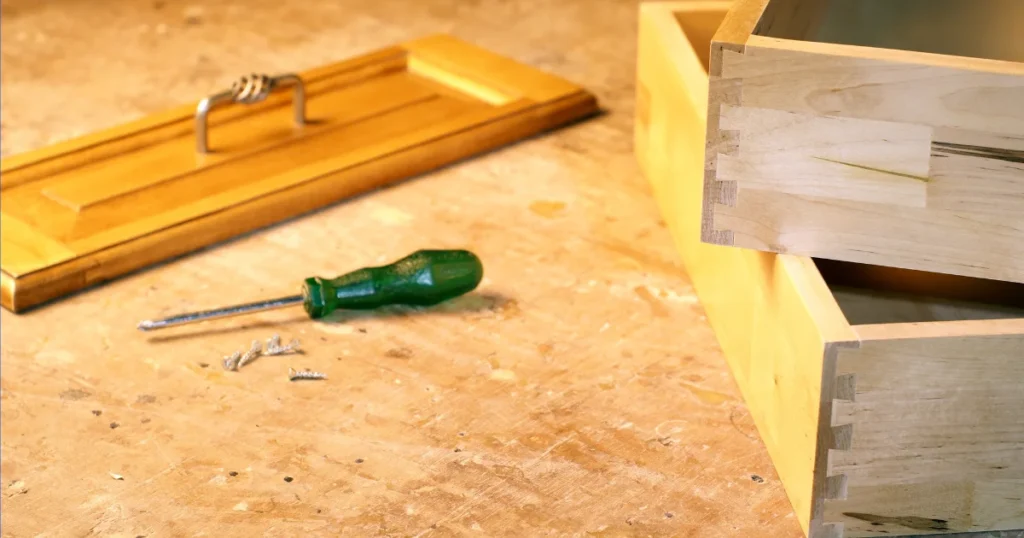
Every dovetail joint relies on two interlocking shapes: pins and tails. The tails are wider, fan-shaped cuts that look a bit like a bird’s spread wings, while the pins are narrower wedges that slot neatly between them. Once glued and pressed together, these pieces lock mechanically, meaning the joint holds firm even if the glue weakens over time. That’s a huge advantage over other drawer joint types, which often rely on adhesive alone. When you look closely at a dovetail corner, you’ll notice a distinctive zigzag pattern. That pattern isn’t just decorative; it’s proof of a mechanically superior connection.
How Dovetail Drawers Differ From Standard Drawer Construction
Standard kitchen drawer boxes often use butt joints, staples, or simple glue-and-nail construction. These methods are faster and cheaper to produce, but they trade durability for speed. A stapled corner can loosen within a few years of daily opening and closing. A dovetailed corner, by contrast, spreads stress evenly across a much larger surface area. That’s why custom dovetail drawers show up so often in higher-end cabinetry. Builders know the extra time spent cutting the joint pays off in decades of trouble-free use.
How Are Dovetail Drawers Made?
Building a proper dovetail drawer box takes patience, precision, and a steady hand, whether that hand belongs to a craftsman or a well-calibrated CNC machine. The process starts with selecting quality lumber, cutting it to size, then carving the interlocking pins and tails along each corner. Once the joints fit snugly, the pieces get glued, assembled, and clamped until fully cured. It sounds straightforward on paper, but getting dovetail drawer construction exactly right requires real skill.
The Craftsmanship Behind Cutting a Dovetail Joint
Cutting dovetails by hand remains something of an art form. Traditional woodworkers use a marking gauge, a fine-toothed saw, and a chisel to carve each pin and tail with painstaking accuracy. Modern cabinet shops often rely on dovetail jigs or computer-guided routers to speed things up without sacrificing quality. Either way, precision matters enormously. If the pins and tails don’t fit tightly, the joint loses much of its strength. That’s why how to make dovetail drawers correctly separates skilled cabinet makers from amateur hobbyists. A loose-fitting joint might look right at a glance, but it won’t hold up to years of real-world use.
Materials Commonly Used in Dovetail Drawer Boxes
Most quality wooden drawer boxes use solid hardwoods like maple, birch, or oak because these species hold detailed cuts well and resist warping. Solid wood dovetail drawers tend to outlast plywood or particleboard alternatives, especially in humid kitchen environments where moisture can weaken weaker materials over time. Some manufacturers also use high-grade plywood for the drawer bottoms while reserving solid wood for the sides, striking a balance between cost and longevity. Either approach beats particleboard, which simply can’t hold a dovetail cut with any real strength.
What Types of Dovetail Joints Are Used in Kitchen Cabinetry?
Not all dovetail joints look or function the same way. Depending on the application, cabinet makers choose from several variations, each offering its own blend of strength and appearance.
| Joint Type | Visibility | Best Used For |
| Through Dovetail | Completely visible on both sides | Exposed joinery, decorative fronts to drawers |
| Half-Blind Dovetail | Hidden from the front, visible on the side | Standard kitchen cabinet drawers |
| Blind Dovetail | Completely hidden | High-end furniture, seamless finishes |
| Sliding Dovetail | Visible along a groove | Shelving and structural cabinet panels |
| Secret Mitered Dovetail | Fully concealed with a mitered edge | Fine furniture, luxury cabinetry |
Through Dovetail Joints
Through dovetails expose the end grain on both pieces being joined together and are easily recognizable for the characteristic zigzag you see on both sides of the joint. They are not intended to be concealed and are therefore a popular choice when showing off the detail of your work in statement furniture or attractive drawers.
Half-Blind Dovetail Joints
With Half-blind dovetails the joinery is completely hidden from the front face of the drawer and you are left with only the angled tails visible on the sides of the drawer front. This join is a great choice for most kitchen drawers and provide maximum strength to the unit while retaining a clean and neat appearance.
Blind (Full-Blind) Dovetail Joints
Blind dovetails completely hide the joint, giving drawers an uninterrupted appearance on all visible sides. This join requires much more skill to cut than any other and so you are likely only find this construction used on high end kitchen units or furniture of high value and good craftsmanship.
Why Are Dovetail Joints So Durable?
Durability is the whole reason dovetail construction exists. Kitchen drawers get opened and closed thousands of times a year, sometimes loaded with heavy pots, dishes, or utensils. A weak joint simply won’t survive that kind of repeated stress.
Interlocking Strength vs. Stapled or Nailed Joints
Unlike staples or nails, which rely on friction and can work loose over time, a dovetail joint locks mechanically. Even if the glue eventually weakens with age, the interlocking shape keeps the corner from pulling apart. This is why durable kitchen drawers almost always feature dovetail construction rather than cheaper alternatives. Are dovetail drawers stronger than regular drawers? Absolutely, the geometry alone gives them a structural advantage that other joints can’t replicate.
How Dovetail Drawers Hold Up to Daily Kitchen Use
The average kitchen drawer opens and closes thousands of times each year. Do dovetail drawers last longer? Generally, yes. Well-built dovetail drawers can last for decades, often outliving other components of the kitchen entirely. Many homeowners also pair them with soft-close dovetail drawer hardware, reducing slamming and further extending the drawer’s lifespan.
Top Benefits of Choosing Dovetail Drawers for Your Hoffman Estates Kitchen
Long-Term Durability and Fewer Repairs
Because the joint distributes weight and stress so evenly, dovetail drawers rarely crack, sag, or separate. That translates into fewer repair calls and less frustration down the road.
Added Home Value and Resale Appeal
Buyers notice quality craftsmanship, even if they can’t always name what they’re seeing. Do dovetail drawers increase home value? Real estate agents and appraisers often point to solid wood construction and quality joinery as selling points, especially in competitive markets around Hoffman Estates.
Timeless Aesthetic and Craftsmanship
Beyond function, dovetail joints simply look beautiful. That interlocking pattern signals genuine cabinet craftsmanship, adding a sense of heritage and quality to any kitchen design.
Dovetail Drawers vs. Other Drawer Construction Methods
Dovetail vs. Doweled Drawers
Doweled joints use round wooden pegs for alignment and strength, but they rely heavily on glue bonds that can weaken with humidity changes. Dovetails distribute stress across a wider surface, making them the sturdier long-term option.
Dovetail vs. Stapled or Butt-Joint Drawers
Are dovetail drawers better than butt joints? Without question. Butt joints are essentially two flat pieces glued or stapled together at a right angle, offering minimal resistance to pulling forces. Dovetails, by comparison, interlock physically, giving them a clear structural edge.
What to Look for in a High-Quality Dovetail Drawer Box
Solid Wood vs. Plywood Drawer Boxes
What wood is best for dovetail drawers? Maple and birch rank among the top choices thanks to their density and resistance to warping. Solid wood generally outperforms plywood for longevity, though quality plywood with a solid wood face frame can still deliver excellent results.
Signs of Skilled vs. Poor Dovetail Craftsmanship
Look for tight, gap-free joints with consistent spacing between pins and tails. Sloppy cuts, visible gaps, or excessive filler putty are red flags suggesting rushed or low-quality work.
Are Dovetail Drawers Right for Your Hoffman Estates Kitchen Remodel?
Key Questions to Ask Your Cabinet Contractor
Inquires regarding wood species and dovetail types that are available, inquire if soft-close dovetail drawer hardware comes as standard, and request a physical example before undertaking an entire kitchen renovation project in Hoffman Estates .
Get a Custom Quote From CPR Home Solutions
Every kitchen has different storage needs, and a quick consultation can help determine which cabinet storage solutions fit your space and budget best.
Why Hoffman Estates Homeowners Trust CPR Home Solutions for Dovetail Drawers
As experienced cabinet makers Hoffman Estates residents rely on, CPR Home Solutions builds every drawer box with genuine dovetail drawer construction, not shortcuts. Whether you’re looking for Hoffman Estates custom kitchen cabinet solutions, or total custom cabinetry Hoffman Estates solutions, they have pride in producing superior quality drawer boxes with the strength you’ll need to stand up to years of use. If you’re looking for Hoffman Estates kitchen storage options with honest, skilled craftsmanship, then give us a call for your kitchen cabinet remodel consultation, and discover why dovetail construction is chosen by many Hoffman Estates residents!
Ready to Transform Your Kitchen?
Now that you know “what are dovetail drawers”, it’s time to put them to work in your kitchen. Contact CPR Home Solutions to schedule a consultation and explore our selection of custom dovetail drawers and premium cabinet drawers. Our team will help you choose the right wood, joint style, and hardware for your space, so your new drawers are built to last. Let’s make your kitchen remodel a success.